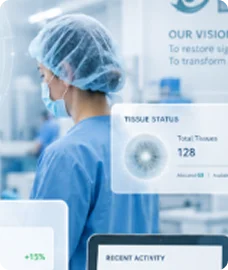
As EBAA 2026 brings the eye banking community together in Indianapolis, the conversations happening in meeting rooms, hallways, and exhibit floors are revealing something important: the industry is at an inflection point. The questions being asked are no longer just about clinical outcomes. They are about operations, infrastructure, and the systems that make everything else possible.
Three themes are dominating discussions this week. First, operational readiness — specifically, the ability to respond to referrals faster, coordinate more effectively, and maintain case momentum across teams that are often distributed across large geographies. Second, traceability — the ability to follow tissue from donor to recipient with complete, unbroken documentation that satisfies regulatory requirements and supports quality review. Third, digital integration — the growing recognition that fragmented tools and manual handoffs are no longer sustainable at the volumes modern eye banks are managing.
What is becoming clear is that operational excellence in eye banking is not achieved through any single improvement. It is the result of multiple systems working together — intake, eligibility, recovery, processing, distribution, and compliance — coordinated in real time across every team involved in a case.
The eye banks leading these conversations are the ones investing in infrastructure that connects these functions. They are not asking whether to digitize. They are asking which platform does it best — and what the real cost of staying fragmented looks like over the next three to five years.
These are exactly the conversations MidWire 20/20 is built for. The platform was designed to answer them — not with a promise, but with a working system that connects every part of the eye banking workflow into a single, visible, traceable operation.